1. Introduction §
1.1. Background and motivation §
For most sighted people across the world, Braille exists largely on the peripheries of their imaginations. Among this cohort, knowledge about Braille, its functioning and its applications has generally been minimal. There exists a minority of sighted Braille users, many of whom are engaged as pedagogues, advocates and allies with the Blind and Visually Impaired (BVI) community. Regardless, it appears uncontroversial to state that most of the world’s sighted population — comprising the vast majority of humanity — know little about how Braille actually ‘works’.
Regrettably, the epistemological marginalization of Braille also holds true within academic circles, including in grapholinguistics. Despite being hailed as “a lighthouse to pierce the darkness of the blind” (Keller in Mackenzie, 1954, p. 5), “a vital tool of literacy” (Dixon in Perkins et al., 2013, p. viii) and “the first effective digitization of writing” (Daniels, 1996a, p. 886), Braille continues to be sidelined in scholarly research and remains chronically understudied (Englebretson et al., 2023, p. 402). Consequently, it remains largely unknown what lessons Braille may hold for refining our understanding of ‘writing’ in graphematic and sociolinguistic contexts.
The resultant misconceptions about Braille have prompted otherwise well-meaning sighted authors to unwittingly characterize it as an embossed notation or code for the visual or inkprint writing system of a language, to enable Blind users to read by touch.1 Such characterizations have been critiqued as visuocentric, since they depict Braille as “a code for print, as derived from print [and] dependent on print” (Englebretson et al., 2023, p. 407). Along similar lines, Braille is sometimes considered a secondary or auxiliary notation system, implying that it acts as a subordinate alternative for a corresponding ‘primary’ writing system. Such portrayals belie the reality of Blind users for whom a Braille-based system is very much their primary mode of reading and writing, and may be the only one they are literate in (Daniels, 1996b, p. 818). Besides, there exists little to no methodical analysis or reliable evidence attesting to Braille’s supposed secondary or subsidiary status, because of which such a characterization essentially remains an opinion. Yet, the numerical dominance of sighted scholars in the academic community has elevated the majority opinion to quasi-consensus status, in the process percolating into BVI authors’ own stances on the issue (Englebretson, 2009, p. 69; Englebretson et al., 2023, p. 408).
Against this background, scholars, pedagogues and advocates have been increasingly calling for Braille to receive greater prominence in academic and popular spheres alike. Within grapholinguistics, Meletis (2020, p. 32, footnote 35) argues that, from a structural standpoint, Braille as used in representing spoken language qualifies as ‘language writing’ and should be considered as such. In the sociolinguistic realm, Klein and Spitzmller (2022) compare the relative prominence of and discourse patterns around Braille and sign language in the German-language press, with the aim of identifying the underlying ideologies in each case.2 They conclude that:
As opposed to sign languages, Braille is still very much stigmatized both in society and academic literature. While sign languages are (rightly) celebrated as languages proper and sign language users as a vivid and strong community, Braille is still perceived as an auxiliary and pathological form of writing/reading of individual persons…
(Klein & Spitzmüller, 2022, 21:13; emphasis in original)
In calling for Braille’s removal from “the blind spot of communication theory and practice”, Klein and Spitzmüller (2022, 21:46) highlight its status as “a proper, and extremely interesting, form of graphic communication”.
A seminal argument to this end is that of Englebretson, Holbrook and Fischer-Braun (2023), who make a compelling case for researching Braille as “a writing system worthy of study in its own right and on its own terms” (p. 400). In addition to their distinct backgrounds in linguistics, education and psychology, the authors of this study represent a mix of Blind and sighted users of Braille at varying levels of proficiency. Drawing on their diverse areas of expertise and lived experiences, they eloquently argue in favor of “decentering the sighted norm” in academic research, highlighting the ramifications of not doing so for BVI and sighted communities alike. Aside from the need to ensure equity and social justice, Englebretson et al. assert that centering Braille and Blind users in pedagogical, cognitive and grapholinguistic investigations would lead to new and insightful findings in these spheres.
The arguments in Englebretson et al. (2023) serve as motivation for the present article. My intention is for this article to serve as an initial step towards the ultimate aim of normalizing Braille as a subject of inquiry in grapholinguistic research. I further hope that the article’s subject matter and findings act as impetus for subsequent efforts of a similar kind, to bring the discipline of grapholinguistics closer to the stated aim.
1.2. Objectives §
Englebretson et al.’s (2023) prediction that foregrounding Braille in research efforts would yield promising outcomes has been partly vindicated by recent work in the pedagogical and cognitive domains (see for example Hoskin et al., 2024; Martiniello & Wittich, 2022; Sheffield et al., 2022). Progress on the grapholinguistic front, however, has been slow. Building on the findings of Meletis (2020) and Klein and Spitzmüller (2022), there have been welcome forays of late into unpacking Braille as used in depicting languages other than English (Fetnaci et al., 2022; Iyengar, 2023, forthcoming). Nevertheless, such works remain few and far between, and Braille is yet to become a routine subject of grapholinguistic exploration comparable to its inkprint counterparts. In particular, there is as yet no dedicated cross-linguistic analysis of Braille that examines its grapholinguistic properties by applying state-of-the-art theory in a rigorous and consistent manner.
Against this background, I investigate in this article how Braille is deployed in transcribing or graphizing various spoken human languages worldwide (henceforth ‘Braille text’). In doing so, I gauge how Braille text might fit into current graphematic and sociolinguistic frameworks and, conversely, how these frameworks account for the manifestations of Braille text across languages. To this end, the specific questions I address are:
-
To what extent does Braille text meet the requirements of glottography, script and writing system as laid out in the academic literature?
With reference to the Modular Theory of Writing Systems (MT) (Meletis, 2020; Neef, 2015), how neatly is Braille text compartmentalizable into the MT’s envisaged modules of graphematic system and orthography? If edge cases emerge, what can they tell us about the underlying properties of Braille text, and about contemporary grapholinguistic theory?
-
Are typological labels like logographic and phonographic applicable to Braille text? If yes, how does Braille text lend itself to the application of granular typological category labels such as abugida, alphasyllabary and alphabet (Bright, 1999; Gnanadesikan, 2017; Iyengar, 2023)?
What lessons emerge from analyzing Braille text using contemporary sociolinguistic approaches such as biscriptality (Bunčić et al., 2016)? How does this analysis validate, contradict and/or refine our current understanding of sociolinguistic phenomena?
By identifying areas of congruence and dissonance between existing theory and Braille-based data, I make observations and preliminary conclusions on the relation of Braille and inkprint text, especially on the appropriateness of characterizing Braille text as ‘language writing’ in the conventional sense.
For consistency with established anglophone grapholinguistic practice, I spell all script names with an initial uppercase letter, as in ⟨Hiragana⟩, ⟨Devanagari⟩ and ⟨Bopomofo⟩. Since Braille will be discussed in a similar context, the word ⟨Braille⟩ is also spelled with initial uppercase ⟨B⟩. This is also the casing convention adopted by Sir Clutha Mackenzie in his seminal reference work, World Braille Usage (1954).
1.3. Limitations §
The story of Braille’s invention (§ 2) highlights the value of end-user involvement when designing a solution, in light of such users’ intimate familiarity and nuanced experiential knowledge with the issue at hand. It follows that touch-readers of Braille would possess subtle insights into the underlying workings of Braille text that may not be readily evident to sight-readers of Braille text like myself. That said, ideational refinement requires collective input, especially on under-researched topics like the current one. It is, therefore, imperative that Blind and sighted researchers of Braille jointly contribute to their shared topic of interest, be it on conceptual questions as in this article, or on real-world practice as in Englebretson et al. (2023). In any event, my conclusions in this article are necessarily preliminary, remain open to ongoing scrutiny, and will inevitably be refined, modified or superseded by future research.
2. Braille: An overview §
The symbol inventory today known as Braille is named after Frenchman Louis Braille (1809–1852), who lost his eyesight in a domestic accident aged three (Australian Braille Authority, 2024a; Mellor, 2006). At ten years old, Braille enrolled at the Institut National des Jeunes Aveugles (INJA; ‘National Institute for the Young Blind’) in Paris, where he learnt to touch-read his native French transcribed in embossed Latin-script letters (Campsie, 2021). He also acquainted himself with tactile transcription systems invented by soldier-turned-philanthropist Charles Barbier, which eschewed Latin-script letters in favor of graphically simple combinations of dots and dashes (Barbier, 1809, 1815). Building on Barbier’s concept of embossed dot-and-dash symbols, Braille began exploring ways to improve the symbols’ tactile perceptibility. By 1825, aged sixteen, he had a prototype ready (Henri in Mackenzie, 1954, p. 18; Tomic, 2025). Soon after, he became a tutor at his alma mater, while continuing to work on his symbol inventory (American Foundation for the Blind, 2024b).
By 1829, Braille had simplified the design template of an individual tactile symbol into a matrix or cell of six dot positions, arranged in three rows and two columns. By raising different dot combinations within a cell, one could create up to 63 distinct embossed symbols. For reference purposes, the six dots were numbered top-to-bottom and left-to-right, as shown in Figure 1.
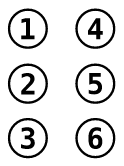
Source: Wikimedia Commons. Copyright 2010 by DePiep. Modified and used under CC BY-SA 3.0.
In place of two dots, a row could comprise a continuous raised dash. Permitting dashes and dots to co-occur within a cell generated an additional 61 symbol options. Together with a blank space, Braille’s inventory provided for 125 unique tactile symbols formed from just two design elements: a dot and a dash. Moreover, the 3 × 2 cell configuration ensured every single symbol would fit neatly under an adult human fingertip, facilitating efficient decipherment (Mackenzie, 1954, Chapter 2). A selection of symbols from Braille’s prototype featuring various dot-and-dash combinations is shown in (1):
-
-
-
-
-
-
By mapping individual embossed symbols onto French-in-Latin letters, digits and punctuation marks, Braille effectively created a parallel standalone transcription system tailor-made for touch-reading. Along similar lines, he harnessed his symbol inventory to devise a tactile system of musical notation. In 1829, the twenty-year-old Braille unveiled his creations in a 32-page booklet, titled Procédé pour écrire les Paroles, la Musique et le Plain-chant au moyen de points, ‘Procedure for writing words, music and plain-song using dots’ (Braille, 1829). The booklet featured embossed samples of his notation systems with accompanying explanatory text in embossed-type French-in-Latin.
Notwithstanding the design simplicity of his creations, Braille was apparently aware that the dash element was not as tactually perceptible as the individual dots. In the booklet’s explanatory text, he concedes:
Le trait qui entre dans le composition des signes… pouvant présenter quelques difficultés a plusieurs de ceux qui étudieront ce procédé ;
[ The dash that enters into the composition of the signs… can present some difficulty to many of those who will study this procedure; ]
(Braille, 1829, p. 12; translation by National Federation of the Blind, n.d.)
By the time the first book-length work typeset in his system appeared in 1837 (American Foundation for the Blind, 2024a), Braille had eliminated the raised-dash symbols from his inventory. His streamlined symbol set now featured 63 distinct cells founded upon a sole design element — a raised dot (Henri in Mackenzie, 1954, p. 19). A century down the line, the INJA’s Pierre Henri would note how his predecessor Louis Braille’s lived experiences as a Blind person were indispensable in informing the symbols’ final design:
[O]nly a blind man [sic] could have arranged dots in groups which exactly correspond to the requirements of the sense of touch. Reduce the number of dots and the available signs become obviously insufficient; add to their number, and the signs can no longer be covered by the finger-tip, nor so easily read . . .
(Henri in Mackenzie, 1954, p. 18)
Louis Braille died young at just 43 years of age, but his creation lived on. Over the following century and a half, his now-eponymous inventory of raised-dot cells became the basis of tactile representation schemes for over a hundred languages globally (Perkins et al., 2013; ScriptSource, 2025). The number continues to increase; in the twenty-first century, Braille representations have been proposed for languages like Inuktitut, Cherokee and even Klingon (Kearney, 2012, 2014, 2019). Louis Braille’s musical notation has also endured, and supplemented by analogous notations in mathematics and phonetics (Englebretson, 2008, 2009; Nemeth, 1973).
With a view to examining the compatibility of Braille text and contemporary grapholinguistic frameworks, Sections 3 to 6 outline relevant terminology and theoretical concepts, and assess their applicability to Braille text. In doing so, relevant insights including noteworthy areas of incongruence are highlighted. The findings are consolidated and summarized in Section 7.
3. Script, writing system and glottography §
The grapholinguistic term for a discrete unit of writing is a graph. It serves as an all-encompassing term that is also less ambiguous than the lay alternatives sign, letter, and character (Iyengar, 2023; Meletis, 2020). For clarity, graphs may be shown enclosed in pipes, as in |A|. An inventory of graphs used to represent human speech in graphical form is termed a script, with the script-language pair constituting a writing system (henceforth ‘WS’) (Iyengar, 2023, forthcoming; Meletis, 2020; Neef, 2015; Weingarten, 2013). A writing system, therefore, comprises two mandatory and distinct components: a spoken language and a written script. The three entities of writing system, language and script “undeniably represent an elusive trinity”, according to Joyce and Masuda (2019, p. 248). Despite the ostensible elusiveness of these intertwined entities, it is imperative that they be clearly identified and conceptually distinguished, particularly in the context of this article. All three concepts fall under the umbrella of glottography or ‘language writing’ — namely the use of graphical symbols to represent units of spoken language, where the spoken units might range from individual speech sounds to entire morphemes and words (Iyengar, forthcoming; Sampson, 2015, p. 21 ff.). Glottography is distinguished from semasiography or ‘meaning writing’ (Gelb, 1963; Sampson, 2015), wherein graphical symbols denote fuzzy concepts or ideas rather than specific sounds or words. Notations that are partially or wholly semasiographic include mathematical formulae, traffic signage and emojis. In deciding if a set of graphical symbols is glottographic or semasiographic, the mode of decipherment — whether visual or tactile — does not play a part (Iyengar, forthcoming).
Per the above, the graph inventories known as Latin (or Roman),
Arabic and Canadian Syllabics (or simply ‘Syllabics’) are
scripts, whereas Swahili-in-Latin, Mandarin-in-Arabic and
Inuktitut-in-Syllabics are WSs. It follows that a particular script
may be used to graphize multiple languages, as in Swahili-in-Latin
and Indonesian-in-Latin. Likewise, a particular language may be
graphized in multiple scripts, as in Mandarin-in-Arabic and
Mandarin-in-Bopomofo. Each of these language-script pairs constitutes
a unique WS. For compactness in writing, a WS’s components may be
denoted by standardized codes or tags (Raymond, 2020) approved
and overseen by the Internet Engineering Task Force (IETF) (Iyengar,
2023; Phillips & Baker, 2009). Thus, Inuktitut-in-Syllabics and
Mandarin-in-Arabic may be represented by the tags iu-Cans and cmn-Arab,
respectively. Such a double-barreled nomenclature transparently
reveals the underlying language and script components for every WS,
with the presence of the language component attesting to the WS’s
glottographic status. Furthermore, the nomenclature reinforces the
conceptual distinction between script and writing system,
and the possibility of pairing any language with any script. In doing
so, the binominal format underscores the fact that any language could
theoretically be written in any script, subtly negating notions of
intrinsic or structural inseparability between a particular language
and script. The IETF’s format permits optional components to be
suffixed as subtags to further delimit the WS based on
fine-grained properties, such as geographical region or orthographic
variant (Iyengar, 2023; Phillips & Baker, 2009).
The concepts of script, WS and glottography are all applicable to
Braille text. As already mentioned, Louis Braille’s eponymous
symbol set of 63 raised-dot cells is used to transcribe a
hundred-plus human languages. In tacit recognition of this fact, the
IETF and related standards bodies have assigned the Braille inventory
the subtag Brai,
consistent with the four-letter format reserved for glottographic
scripts (Phillips & Baker, 2009; ScriptSource, 2025). This makes
Braille a script and its individual cells potential graphs. The
qualifier potential accounts for the fact that some of the
available 63 cells may go unused in graphizing a particular language,
although such superfluity is happenstance. Surplus Braille cells in
the context of a certain language might well constitute graphs with
identifiable linguistic values when transcribing other languages. Two
or three Braille cells may also be juxtaposed and utilized as
digraphs
and trigraphs
that function as a cohesive unit with specific linguistic or
paralinguistic values. The occurrence of such compound graphs in
Braille text neatly mirrors the analogous phenomenon in inkprint.
Take for example the English-in-Latin digraph ⟨sh⟩
and the English-in-Braille digraph ⟨⠎⠓⟩,
both of which map onto the English phoneme /ʃ/. By
definition, every language graphically represented using the Braille
script constitutes a unique writing system, and can be denoted with
the corresponding WS tags. Thus, French-in-Braille,
English-in-Braille and Zulu-in-Braille are all instances of WSs,
whose tags are fr-Brai, en-Brai and zu-Brai,
respectively. In each of these systems, the Braille inventory is the
script component, with individual Braille cells acting as graphs.
Moreover, since these WSs constitute the written representation of a
spoken language, they are indisputably glottographic in nature.
The fact that Braille satisfies the accepted grapholinguistic
definitions of script, WS and glottography is also consistent with
historic — if isolated — observations of the
phenomenon. In Writing Systems of the World, Daniels (1996b,
p. 818) asserts that English-in-Braille as used in the United States
(en-Brai-US)
is not simply “a variety of English[in-Latin] orthography, but
rather an independent writing system”. In her textbook on writing
systems, Gnanadesikan (2009) alludes to Braille text to demonstrate
that the mode of decoding is inconsequential to a WS’s
glottographic status:
[B]eing visible is not crucial to [the] definition [of writing]. Braille, for example, is a writing system [≈ script] for the blind designed to be felt with the fingers. It represents letters as a series of raised bumps that can be read by touch.
(Gnanadesikan, 2009, p. 3)
More recently, Honda (2021, p. 631, footnote 13) notes that “Japanese
braille (点字 tenji) constitutes a separate tactile writing
system which has different formal and functional properties from its
multi-script visual writing system”. Fetnaci, Haralambous and Varin
(2022) demonstrate the systematic similarities and differences
between the Arabic language transcribed in Braille (ar-Brai)
and in the homonymous inkprint script (ar-Arab),
and in doing so explicitly describe Arabic-in-Braille as a writing
system. These recent conclusions are especially valuable as they
attest to and affirm Braille’s ongoing usage as a glottographic
script for a variety of mutually unrelated languages across the
world.
4. Graphematic system and orthography §
Within a writing system, the correlation of written units from the
script component to spoken units from the language component is
termed the graphematic
system, or simply graphematics
(Iyengar, forthcoming; Meletis, 2020; Neef, 2015). The
representational possibilities offered by the graphematic system may
be constrained and occasionally overridden by the optional layer of
orthography
(Honda, 2021; Iyengar, 2023, 2024). For instance, the ‘bare’
en-Latn
graphematic system may permit or license multiple ways of
graphizing a particular word, as in ⟨color⟩
and ⟨colour⟩.
A superimposed orthographic layer often limits the range of written
forms available to users by prescribing one and proscribing the
others. The choice of orthography depends on the text’s intended
users and use. Thus, an English-in-Latin text written by or for
American users would typically feature the written form ⟨color⟩.
Put differently, a bare graphematic system may have different
orthographic ‘veneers’ applied by different user groups. A
particular graphematic system subject to distinct orthographic
layers — as in en-Latn-US
and en-Latn-GB — represent
distinct sets of spelling rules within a given WS (Iyengar,
forthcoming, Chapter 2).
4.1. Orthographic variants §
The concepts of orthography and spelling apply neatly to
Braille-based writing systems. Until the turn of the twenty-first
century, countries around the world used en-Brai
with distinct but mutually intelligible conventions. In other words,
countries utilized en-Brai
under distinct but mutually intelligible orthographies, not
unlike the contemporary usage of en-Latn
globally. As with en-Latn,
the most prominent English-in-Braille orthographies were those
followed in the United States and United Kingdom — en-Brai-US
and en-Brai-GB
respectively (Cranmer & Nemeth, 1991; International Council on
English Braille, 2012; Bogart & Koenig, 2005). Following
sustained effort and collaboration over several years, a revised and
consolidated set of written conventions was released and steadily
adopted around the world over the first two decades of the
twenty-first century (Australian Braille Authority, 2024b). The
revised set of conventions is known as Unified English Braille
(UEB) and essentially constitutes a new English-in-Braille
orthography (en-Brai-x-ueb)
that supersedes the erstwhile standard orthographies of
en-Brai-US
and en-Brai-GB.3
4.2. Graph inventories §
Along
similar lines, Braille-based WSs for other languages have also been
subject to differing orthographic standards based on region or
jurisdiction. As with en-Brai,
the existence of variant orthographies within the same Braille-based
WS are often traceable to a sustained and complex interplay of
historical, cultural and political factors. Unlike en-Brai,
however, other Braille-based WSs may feature mutually unintelligible
orthographies that require targeted learning. For instance,
Urdu-in-Braille (ur-Brai)
is subject to conspicuously distinct spelling conventions in Pakistan
and India (Iyengar, forthcoming, Chapter 11; Perkins et al., 2013,
pp. xvi, 68, 104). An illustrative example is shown in (2).
Consequently, BVI readers conversant in either ur-Brai-PK
or ur-Brai-IN — but
not both — might find themselves effectively cut off from
a significant body of Urdu-language literature in Braille. This is an
unfortunate scenario considering the paucity of material in Braille
and the accessibility barriers that BVI users already face. That
being said, the situation is also speculative; there is as yet no
rigorous analysis available on the impact of cross-border
orthographic differences on ur-Brai
readers.
ur-Arab
|
تَمام اِنسان آزاد اَور بَرابَر پَيدا ہُوے ہَيں۔ |
ur-Brai-PK
|
⠞⠂⠍⠁⠍⠀⠁⠑⠝⠎⠁⠝⠀⠜⠵⠁⠙⠀⠁⠂⠺⠗⠀⠃⠂⠗⠁⠃⠂⠗⠀⠏⠂⠽⠙⠁⠀⠓⠥⠺⠊⠀⠓⠂⠊⠰⠲ |
ur-Brai-IN
|
⠞⠍⠜⠍⠀⠊⠝⠎⠜⠝⠀⠜⠵⠜⠙⠀⠪⠗⠀⠃⠗⠜⠃⠗⠀⠏⠽⠙⠜⠀⠓⠥⠺⠑⠀⠓⠌⠰⠲ |
en-Latn translation
|
All human beings are born free and equal. |
On the
mutual differences between Pakistani and Indian ur-Brai,
a closer analysis reveals divergences at a deeper level, including in
the phonetic values of certain graphs. Consequently, one may argue
that the differences between ur-Brai-PK
and ur-Brai-IN
are not merely orthographic. Instead, they are graphematic,
since they extend down to the graph inventory. However, unambiguously
categorizing dimensions of difference as orthographic or graphematic
proves contentious, as no consensus exists on determining the
boundary between a WS’s graphematic system and orthography (Honda,
2021; Iyengar, forthcoming, Chapter 2; Meletis, 2020). Indeed, the
dilemma may well remain unresolved until theoretical advancements are
made and more sophisticated analytical tools are developed.
The above finding also dovetails with
the core reason for the disparity between Pakistani and Indian
Urdu-in-Braille. Whereas ur-Brai-PK
is modelled on Arabic-in-Braille, ur-Brai-IN
is based on a common set of graphematic principles and orthographic
conventions for transcribing the official languages of India into
Braille. These pan-Indian Braille conventions are officially known as
Bharati Braille (IIT Madras, 2020; Iyengar, 2023, 2024)
and represent a noteworthy instance of a
graphematic-system-plus-orthography being employed by multiple WSs.
In principle, a person literate in any Bharati-Braille-based
WS could be considered literate in all of them.4
Identifying a comparable example among inkprint WSs proves elusive.
Nor does there appear to be an equivalent among inkprint WSs for the
paradox embodied by Urdu-in-Braille, wherein an Urdu speaker from
India literate in ur-Brai-IN
may struggle to comprehend same-language or homoglottal
text transcribed in ur-Brai-PK
conventions, but could in principle decipher other-language or
heteroglottal
text transcribed in Bharati Braille WSs. The noteworthy instance of a
given language-script pair manifesting in two starkly divergent
variants with limited mutual intelligibility reiterates the
classificatory dilemma identified earlier: Are ur-Brai-PK
and
ur-Brai-IN
instances of the same writing system differing only in their
orthographic veneers, or does the divergence go deeper? If the
latter, in which layer of the writing system is the difference
supposed to exist, and why? These questions may have never arisen had
our focus been restricted to inkprint WSs.
Regardless of inventorial differences
between ur-Brai-PK
and
ur-Brai-IN,
individual graphs in both variants are exclusively six-dot (Iyengar,
forthcoming, Chapter 11). This contrasts with the situation of
Japanese-in-Braille (ja-Brai),
which may manifest in three different avatars — the
official tenji variant, and the unofficial tenkanji and
kantenji variants. Of these, the graph inventories of tenji
and tenkanji only comprise six-dot cells (Dasgupta, 2002;
Dixon, 2007), while kantenji employs eight-dot cells (Dixon,
2007; Nagoya Braille Network, 2006).5
The inventorial diversity among the ja-Brai
variants reiterates the classificatory dilemma posed by
ur-Brai — do
these inventorial distinctions exist within the orthography,
graphematics, or some other layer? As already noted, this question
may not be satisfactorily addressable at the current level of
grapholinguistic theory, and likely requires developing innovative
analytical approaches. It is in posing such classificatory conundrums
that Braille-based WSs demonstrate their value to grapholinguistics.
By exhibiting behavior unattested among inkprint WSs, Braille-based
WSs challenge the status quo and invariably spur conceptual
refinements.
4.3. Paralinguistic features §
In spite of their divergent inventories, ur-Brai-PK
and ur-Brai-IN
are both written left-to-right, top-to-bottom (LR-TB), in contrast to
the right-to-left (RL-TB) directionality of their inkprint
counterpart of Urdu-in-Arabic (ur-Arab;
see (2)).
Although seemingly anomalous at first glance, the differing
directionalities of ur-Brai
and ur-Arab is
actually consistent with historical and current practice across WSs.
Mandarin-in-Han characters (cmn-Hani)
and Mandarin-in-Bopomofo (cmn-Bopo)
can be written LR-TB or top-to-bottom, right-to-left (TB-RL), as can
the related WSs of Japanese in Kanji-and-Kana (ja-Jpan),
and Korean in Hanja-and-Hangeul (kr-Kore).6
Mandarin-in-Latin variants such as Hànyǔ Pīnyīn
(cmn-Latn-pinyin)
and Wade-Giles (cmn-Latn-wadegile)
are written LR-TB in line with Latin-script WSs worldwide.
Mandarin-in-Arabic (cmn-Arab)
or Xiǎo'érjīng is written RL-TB consistent with other
Arabic-script WSs, including ur-Arab.
In short, the directionality of a WS is more often conditioned by the
directionality of homographic WSs than homoglottal
ones. It is, therefore, normal and consistent for Urdu-in-Braille to
follow the canonical LR-TB directionality of Braille-based WSs
worldwide, independently of the directionality of Urdu-in-Arabic. The
fact that Braille systems are no different from their inkprint
counterparts on matters of writing directionality only underscores
the systemic equivalence of the two. These underlying parallels were
not lost on the BVI pioneers of Braille standardization, who noted in
a 1949 UNESCO report that:
[t]he script of every language is both written and read in a traditional direction — Chinese from top to bottom of the page, Persian, Urdu and Hebrew from right to left, Roman, Greek and Devanagari from left to right. Braille is traditionally read from left to right, and the Brailles of Japanese, Korean, Chinese, Malay, Urdu, Persian and Hebrew conform, not to the conventions of their visual scripts, but to the Braille convention.
(Advisory Committee on Braille Problems, 1949, quoted in Mackenzie, 1954, p. 34)
Despite their systemic equivalence, a conspicuous difference between
inkprint and Braille-based WSs is the latter’s limited inventory
size, especially the six-dot variant. While the former allows the
creation of arbitrary graphs as required, Braille’s design
simplicity and typographical constraints rule out the option of
conjuring up arbitrary derivative graphs. As a result, Braille-based
WSs may convey paralinguistic information through novel bespoke
conventions. Where the inkprint WS is bicameral and distinguishes
between uppercase and lowercase letterforms, the corresponding
Braille WS may feature a standalone capital marker graph. The capital
marker usually precedes a regular ‘lowercase’ graph, with the
resultant digraph interpreted as the ‘uppercase’ equivalent. A
string of uppercase letters, as in heading text, may be portrayed by
two or more instances of the capital marker placed at the start and
end of the string. While the specific Braille cell chosen as the
capital marker may differ across WSs, the underlying operation
remains consistent and comparable. Thus, Dot-6 ⠠
serves as the capital marker in Armenian (hy),
Bulgarian (bg) and English
in Braille, whereas Dots-46 ⠨ fulfils
the same role in Greek (el),
French and Ukrainian (uk) in
Braille (Perkins et al., 2013). To clarify, the existence of a
Braille capital marker suggests that the corresponding inkprint
writing system is bicameral. The script component of
the inkprint WS is inconsequential, be it Armenian (Armn),
Cyrillic (Cyrl), Greek
(Grek), Latin or any
other. Similar to the capital marker, bold and italic typeface in
inkprint may be denoted by standalone graphs in Braille, indicating
emphasis or distinctness from the surrounding text.
Although conveying semantic or phonological cues through standalone graphs may seem unusual to some readers, there exist comparable practices in inkprint WSs. For instance, inkprint text representing a verbatim quote is enclosed within standalone quotation marks. In setting off the target text in a perceptibly distinct manner, the effect of graphically standalone quotation marks is akin to that of graphically superimposed bold or italic typeforms. Similarly, standalone question marks and/or exclamation marks may be used to convey surprise or incredulity, much like uppercase typeforms are used to convey heightened emotions. In short, semantic and phonological information across Braille and inkprint WSs may be encoded as dedicated standalone graphs or as typographical variants of existing graphs. Each manifestation has advantages that influence its adoption and use. Uppercase, bold and italicized typeforms are visually conspicuous but cause inventorial bloat, as equivalent typeforms must be designed for every lowercase graph in the script. In contrast, quotation and punctuation marks may be visually understated, but prove inventorially economical. Considering the inventorial constraints on Braille-based WSs and the exigencies of touch-reading, it is unsurprising that standalone graphs are the preferred method of conveying paralinguistic information in Braille text.
5. Contractions §
A corollary of indicating linguistic and paralinguistic information through standalone graphs is a concomitant increase in text length, which may potentially increase writing effort and slow down reading (Englebretson et al., 2023, p. 406; Fischer-Baum & Englebretson, 2016, p. 163). Previously, it also meant increased costs of publishing and disseminating hard copy, potentially impacting the affordability of Braille publications. To mitigate these issues, Braille user communities or graphospheres (Franklin, 2011; Iyengar, forthcoming, Chapter 2) may devise shorthand methods of representing certain sound and letter sequences, along with abbreviated forms of commonly occurring words. A shorthand or abbreviated form is known as a contraction. A standardized set of permissible contractions and spelling rules is termed a grade. ‘Full’ or uncontracted spelling is customarily labelled Grade 1 and its contracted counterpart Grade 2 (Iyengar, forthcoming, Chapter 11). Both grades may be taught to school-age and adult learners as standard components of Braille literacy curricula. Certain graphospheres may employ multiple grades with increasing levels of contracted spelling (Mackenzie, 1954, Chapter 8). As evident, the higher the grade, the greater the literacy skills required to decipher it. Thus, a Braille text intended for beginner readers might feature uncontracted Grade 1 spelling, whereas material for fluent readers might be in Grade 2 (or Grade 3 where applicable) (Englebretson et al., 2023, pp. 406–407; Perkins et al., 2013, p. 46).
5.1. Grades as orthographies §
In Section 4.1
en-Brai-GB,
en-Brai-US
and en-Brai-x-ueb
were described as having mutually differing written
conventions, and were labelled orthographies of English-in-Braille.
The ‘written conventions’ in question also encompass contraction
rules, which suggests that the various grades of a Braille-based WSs
constitute distinct orthographies within that system. The graphematic
categorization of grades as orthographies is consistent with
Englebretson et al.’s (2023,
pp. 406–407) portrayal of contractions
under the heading “Braille orthography”. Deploying contractions
as standard practice has normalized their presence in Braille text.
While debate may exist on granular aspects of contractions, the practice of using contractions in Braille-based WSs is commonplace and,
consequently, uncontroversial. The sociolinguistic legitimacy of
abbreviated forms in Braille text stands in stark contrast to
corresponding situations in inkprint contexts, where adhering to
standardized uncontracted spellings is typically the unquestioned
norm. Compared to Braille text, standardized abbreviations in
inkprint text are far fewer in number and typically restricted to
specific domains or contexts, such as personal or professional titles
like ⟨Mrs.⟩
or ⟨Dr.⟩.
In general, sighted readers of inkprint text would be less
tolerant of abbreviations in running text than BVI users of Braille
text would. The former would tend to view contracting or truncating
as unacceptable or shoddy practice. The sociolinguistic disdain for
abbreviated writing may spill over onto the author of such text,
leading to negative assumptions about the writer’s skill,
educational background or moral character. Indulgence in
such gratuitous assumptions betrays the comparative
facility of reading and writing in uncontracted spelling for
sight-readers of inkprint text, compared to touch-readers of Braille
text. The relative ease of reading and writing in uncontracted
spelling frees sighted users from the need to devise contracted
written forms for expediency, and spares them the added pedagogical
burden of learning two orthographies for the same WS. Consequently,
when confronted with the task of deciphering shorthand writing, a
sighted reader might subconsciously resist the cognitive load it
entails, and express their displeasure in the form of ad hominem
value judgements — say, that the writer is choosing to be
lazy. For Braille users, however, laziness may not be an option. Depending on the graphosphere, not being proficient in both grades, uncontracted and contracted, would
effectively amount to incomplete literacy acquisition and likely pose
real-world hurdles for the Braille user in question.
5.2. Typological categorization §
The above observations on ‘full’ and contracted writing are primarily applicable to phonographic writing systems or phonographies — WSs that aim for a ‘one-letter-one-sound’ representation of speech (Iyengar, 2023). Gnanadesikan (2017) dubs such systems vowelled segmentaries. In the literature, they are often labelled alphabetic (Daniels & Bright, 1996), though alphabetic systems are better understood as a specific subtype of phonographic WSs (Bright, 1999; Gnanadesikan, 2017; Iyengar, 2023). At the other end of the typological spectrum are logographic writing systems or logographies. They embody the principle of ‘one-letter-one-word’, where an individual written graph typically maps onto a spoken word or morpheme. The fundamental distinction between logographic and phonographic systems, therefore, lies in the smallest unit of speech they seek to represent, known as their grain size (Gnanadesikan, 2017). For phonographies, the grain size is the phonological segment, whereas for logographies, it is the morpheme. Depending on the spoken language in question, morpheme boundaries may coincide with word boundaries, because of which the grain size of logographies is often portrayed as the word (Iyengar, forthcoming, Chapter 2).
Regardless of their nominal grain size, individual WSs invariably
feature graphs at various levels of granularity, spanning the
typological spectrum from phonographic to logographic. Thus,
en-Latn
canonically comprises phonograms like ⟨n⟩
that stand for a single speech sound, but also features logograms
like the ampersand symbol ⟨&⟩,
denoting an entire spoken word or morpheme. The logographic form ⟨&⟩
co-exists with the phonographic form ⟨and⟩,
with the two constituting distinct written representations of the
same spoken entity. Likewise, en-Brai
primarily comprises phonograms like ⟨⠝⟩
/n/ but also features logograms like the ampersand ⟨⠈⠯⟩,
equivalent to en-Latn
⟨&⟩.7
The graph ⟨⠈⠯⟩
is the logographic counterpart to the phonographic form ⟨⠁⠝⠙⟩
corresponding to en-Latn
⟨and⟩.
In addition, the vast majority of WSs, whether tactile of visual,
comprise a set of digits or numerals that serve as logograms for
‘number words’ in the corresponding spoken language (Iyengar,
forthcoming, Chapter 2). Thus, en-Latn
⟨5⟩
and ⟨five⟩
are logographic and phonographic representations, respectively, of
the English word pronounced /faɪ̯v/, as are en-Brai
⟨⠼⠑⟩
and ⟨⠋⠊⠧⠑⟩.8
Hence, en-Latn
and en-Brai
are both predominantly phonographic WSs with a notable subset of
logograms. Needless to say, their manifestation in inkprint or
tactile format is irrelevant to their typological classification, and
to their status as full-fledged standalone writing systems.
Despite their systemic equivalence, en-Brai
differs from en-Latn
in its range and applicability of contracted forms. Besides the
ampersand symbol ⟨⠈⠯⟩,
the Grade 2 orthography of en-Brai
also licenses ⟨⠯⟩
as a contracted alternative to the sequence ⟨⠁⠝⠙⟩.
Whereas ⟨⠈⠯⟩
denotes the English word pronounced /ænd/, ⟨⠯⟩
is a purely graphical substitute for the written sequence
⟨⠁⠝⠙⟩
wherever it may occur. Thus, en-Latn
⟨pandemic⟩
and ⟨Andy⟩
may appear in en-Brai
as uncontracted ⟨⠏⠁⠝⠙⠑⠍⠊⠉⟩
and ⟨⠠⠁⠝⠙⠽⟩,
or as contracted ⟨⠏⠯⠑⠍⠊⠉⟩
and ⟨⠠⠯⠽⟩
(Simpson & Horspool, 2024, p. 118). In these examples, only the
sequence ⟨⠁⠝⠙⟩
is replaced by ⟨⠯⟩;
all other features remain unaffected. This includes the Dot-6 ⠠
uppercase marker in ⟨⠠⠁⠝⠙⠽⟩
and ⟨⠠⠯⠽⟩,
both corresponding to en-Latn
⟨Andy⟩.
At a granular level, the en-Brai
contraction
⟨⠈⠯⟩
has lexico-semantic significance and qualifies as a logogram, as
opposed to the semantically empty contraction ⟨⠯⟩
that acts only as a superficial literal alternative. The semantically
empty subset of Braille contractions exemplifies the Rebus principle
in action, whereby a graph is used primarily for its
phonological-graphematic connotations than for any semantic
significance (Gnanadesikan, 2009). From a broader systemic
perspective, en-Brai
licenses orthographic maneuvers like Rebus-based contractions that
are graphematically possible but sociolinguistically proscribed in
en-Latn.
Juxtaposing the relative frequency and range of abbreviated forms in
en-Brai
and en-Latn
text lays bare the societally conditioned nature of en-Latn’s
proscription on such practice. Indeed, the pragmatically-motivated
permissibility and standardization of contracted forms in
en-Brai
offers valuable food for thought on the distinct approaches and
attitudes at play among their respective user groups.
In addition to the phonograms and logograms of en-Brai,
Braille-based WSs for other languages may feature written forms
spanning the entire typological spectrum. Some of them may be
typologically akin to their inkprint counterparts, like en-Brai
and en-Latn.
For instance, Mandarin-in-Braille (cmn-Brai)
represents syllable onsets and rimes with distinct graphs, as does
Mandarin-in-Bopomofo (cmn-Bopo).
Both systems may be classified as semisyllabaries
(Englebretson et al., 2023, p. 405). The fully vowelled or
graphovocalized avatars of Arabic-in-Arabic (ar-Arab)
and Hebrew-in-Hebrew (he-Hebr),
with bound vowel symbols or diacritics explicitly written, qualify as
alphasyllabaries
(Bright, 1999; Gnanadesikan, 2017; Iyengar, 2023). Arabic-in-Braille
(ar-Brai) and
Hebrew-in-Braille (he-Brai)
manifest in much the same manner.9
The inkprint abugidas
of South and South-East Asia, such as Hindi-in-Devanagari
(hi-Deva) and
Tamil-in-Tamil (ta-Taml)
are typological category-mates with the abugidic Hindi-in-Braille
(hi-Brai)
and Tamil-in-Braille (ta-Brai)
(Iyengar, 2023).
Notwithstanding these examples, there exist numerous instances of
Braille-based WSs diverging from their inkprint parallels. For all
its congruence with cmn-Bopo,
the semisyllabic cmn-Brai
remains typologically distinct from its other homoglottal
systems — namely the archetypally logographic
Mandarin-in-Han characters and the phonographic
Mandarin-in-Latin (§ 4.3).
Whereas hi-Brai
and ta-Brai
share abugidic properties with hi-Deva
and ta-Taml,
the pairs also differ in noteworthy ways. Among these abugidic WSs,
the inkprint ones also qualify as alphasyllabic thanks to their use
of bound vowel graphs in specific environments. In contrast, the
Braille-based abugidas employ free vowel graphs in all contexts and,
therefore, count as alphabetic. For a detailed analysis,
consolidation and taxonomy of abugidic, alphasyllabic and alphabetic
WSs, including Braille-based systems, see Iyengar (2023).
The list of Braille-based WSs notable for their typological features
is by no means restricted to the above examples. Indeed, a cursory
overview reveals the potential they hold for advancing our awareness
of graphematic possibilities. The aforementioned six-dot tenji
variant of Japanese-in-Braille (ja-Brai-x-tenji; § 4.3)
appears to be a syllabary at first glance, much like its kana-based
inkprint parallels. However, a closer investigation reveals that
specific dots within an individual Braille cell are earmarked for
vowel and consonant sounds. Dots 1, 2 and 4 in
ja-Brai-x-tenji
are almost exclusively used to denote vowel sounds, whereas Dots 3, 5
and 6 are typically used for consonant sounds. A comparison of
consonant-vowel graphs and vowel-only graphs in
ja-Brai-x-tenji
is shown in (3).
| [ka] | [ki] | [ku] | [ke] | [ko] |
| ⠡ | ⠣ | ⠩ | ⠫ | ⠪ |
| [a] | [i] | [u] | [e] | [o] |
| ⠁ | ⠃ | ⠉ | ⠋ | ⠊ |
Englebretson et al. (2023, p. 405) categorize ja-Brai
as an abugida, specifying that an individual cell typically
represents a mora. While the moraic nature of an individual
ja-Brai
cell seems self-evident, the abugidic label is at odds with Iyengar’s
(2023) taxonomy and characterization of abugidas. In addition,
ja-Brai’s
discrete representation of vowel and consonant sounds within a
Braille cell, along with the ability of vowel-specific dots to occur
independently of consonant-specific dots (see (3)),
come across as quintessentially alphabetic properties. The tenji variant of Japanese-in-Braille, therefore, appears to exhibit
syllabic-moraic properties at the individual graph level, while
operating alphabetically at the sub-graphical level. In this regard,
ja-Brai-x-tenji
may have much in common with Korean-in-Hangeul (ko-Hang).
While the matter requires further scrutiny and extensive examination
that is beyond the scope of this paper, it is no doubt a worthwhile
and promising endeavor. Yet again, the value of including
Braille-based WSs in grapholinguistic explorations is plainly
evident.
6. Biscriptality §
The preceding sections have revealed the overwhelming evidence that exists in favour of Braille as a full-fledged script in every sense of the term. By extension, transcriptions of spoken human languages in Braille are essentially writing systems, equivalent and comparable to any inkprint WS. In addition to their role in expanding graphematic horizons, the Braille script and its associated WSs also contribute towards refining prevailing sociolinguistic concepts.
As alluded to in Section 2, Braille has been used to graphize between 100 and 130 languages globally, including nearly every major global language (Perkins et al., 2013; ScriptSource, 2025). Notably, every language graphized in Braille also has an inkprint form. There appears to be no evidence of a human language that has only ever been transcribed in Braille but never in an inkprint script. As a result, every language with a Braille-based WS emerges as biscriptal (Bunčić et al., 2016). It follows that over a hundred languages worldwide, including the major ones, are biscriptal in an inkprint script and in Braille (see for example Figure 2). This reality puts paid to the stereotype that biscriptality — namely a language being contemporaneously written down in more than one script, orthography or typographic style (Bunčić, 2016a, p. 51) — is somehow unusual or anomalous. If anything, the existence of Braille-based WSs demonstrate the ubiquity of biscriptality, and should prompt a thorough revisiting and reshaping of the prevalent narrative around this sociolinguistic phenomenon.10
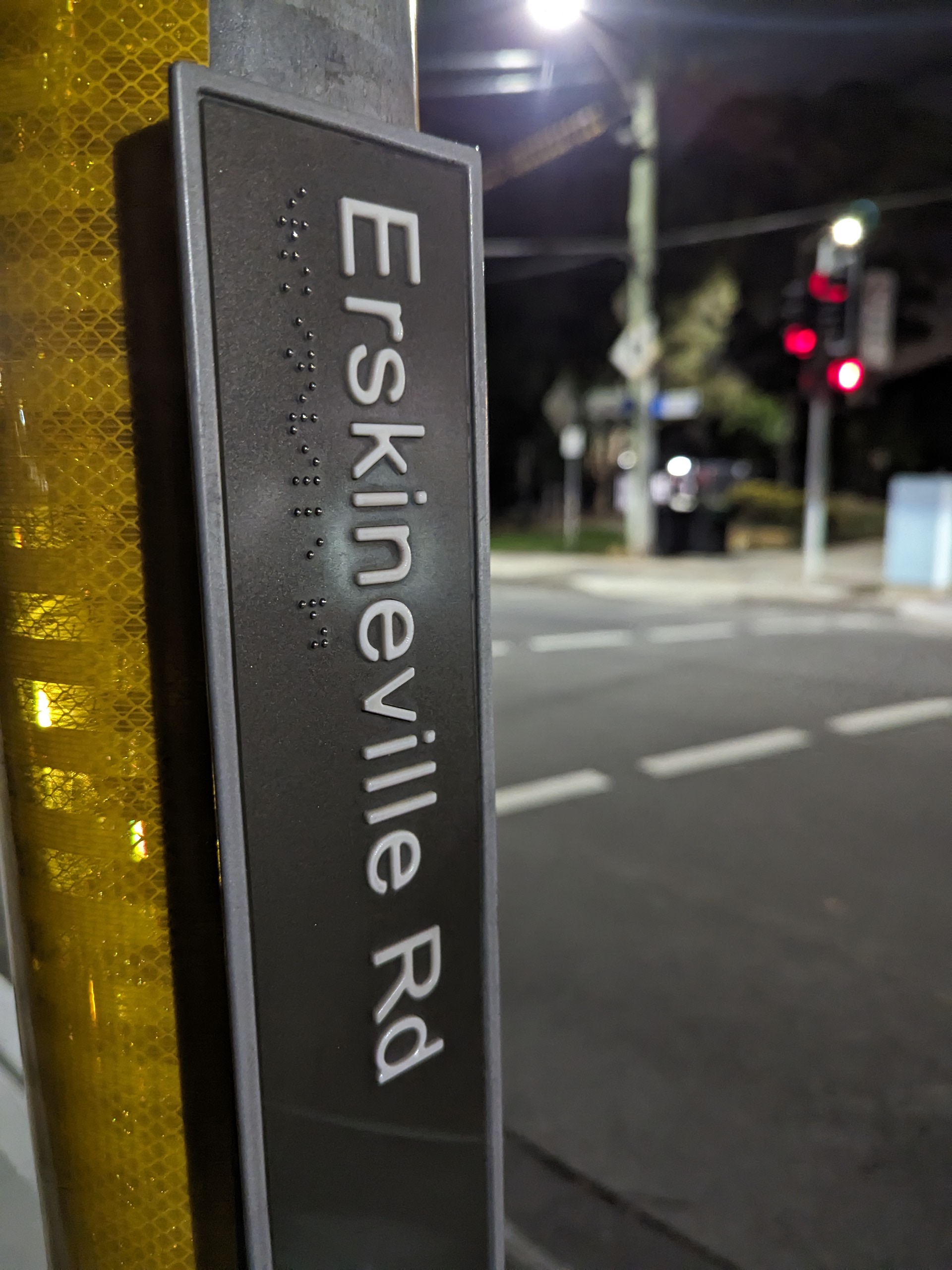
en-Latn ⟨Erskineville Rd⟩ and en-Brai ⟨⠑⠗⠎⠅⠊⠝⠑⠧⠊⠇⠇⠑⠀⠗⠙⟩. The en-Brai
text lacks the Dot-6 capital marker ⟨⠠⟩, consistent with Braille signage in the area. (Source: Arvind Iyengar)
Along similar lines, the existence of distinct regional orthographies and contraction grades within a given Braille-based WS (§ 4.1 & 4.2) affirms the concepts of orthographic pluricentricity and biorthographism (Bunčić, 2016a, p. 67), wherein specific WS-internal orthographies may be adopted based on user group or context.
7. Conclusions and future directions §
The copious evidence attesting to Braille’s status as a script and
as a constituent component of writing systems should hopefully put to
rest any grapholinguistic reservations in that regard. In addition to
spurring further research and discussion on the topic, the acceptance
and legitimization of Braille as a script within academic circles
will ensure consistency with its graphematic characterization in
non-academic contexts. For instance, the latest eBraille standard for
marking up electronic text in Braille mandates the use of the IETF
script subtag Brai for
such text, implicitly affirming the inventory’s status as a script:
The language code MUST include the script subtag
Braito indicate the text is encoded in braille.(eBraille Working Group, 2025, Section 5.3.3.5; emphasis in original)
The eBraille standard also cites language tags for several
Braille-based WSs and their subvariants, including Italian–in-Braille
(it-Brai),
English–in-Braille as used in the USA (en-Brai-US),
French–in-Braille as used in France (fr-Brai-FR)
and German–in-Braille as used in Germany (de-Brai-DE).
The coupling of the script subtag Brai
with various language and country subtags further validate Braille’s
role as a script for a host of world languages, and affirm the
existence of country-specific orthographies within Braille-based WSs.
Aside from their graphematic significance, these findings prompt some
pertinent sociolinguistic questions.
Based on the prevalent — if mistaken — normalization of monoscriptality, governments around the world rarely recognize multiple scripts for a particular language at the official level. Considering that nearly every major language in the world is biscriptal in an inkprint script and in Braille, is there an argument for governments worldwide to formally recognize the Braille-based WSs of their official languages, alongside inkprint WSs? Can the government of a region or nation-state legitimately withhold official recognition from the Braille manifestations of its official languages and still remain compliant with applicable laws? Are there tenable arguments against according official recognition to a language written in Braille while justifying similar recognition to the same language written in an inkprint script? Individualized and comparative evaluations on these matters would prove immensely revealing from a sociolegal perspective. But even in the absence of these insights, it is quite obvious that global legal recognition for Braille-based WSs trails that of signed languages. Whereas a handful of governments like those of New Zealand and Zimbabwe officially recognize signed languages on par with certain spoken languages in their respective territories (Constitution of Zimbabwe, Section 6; New Zealand Sign Language Act, 2006), evidence is scant for governmental recognition of a Braille-based WS on par with inkprint ones. The inconsistency in legal recognition for the signed and tactile-graphical modes of human language aligns with Klein and Spitzmüller’s (2022) observations on how society perceives the two modes (§ 1).
The lack of legal recognition for Braille-based WSs is especially palpable in the European context. As a script created in Europe, Braille is arguably on an equal footing with the Latin, Greek and Cyrillic scripts. More importantly, while most European languages today are typically written in only one of the three aforementioned inkprint scripts, every one of these languages is biscriptally written in Braille. As the only script common to all European languages, the sociolegal inconspicuousness of Braille compared to its inkprint counterparts is striking. For instance, the absence of the Braille-script text ⟨⠑⠥⠗⠕⟩ from euro currency notes (Figure 3) contrasts with the planned and systematic inclusion of the Cyrillic-script text ⟨ЕВРО⟩ following the entry of Bulgaria as a European Union (EU) member in 2007 (European Central Bank, 2025a).
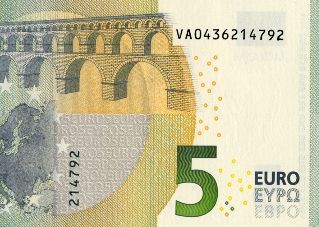
Latn
⟨EURO⟩,
Grek
⟨ΕΥΡΩ⟩
and Cyrl
⟨ЕВРО⟩Source: Wikimedia Commons. Copyright European Central Bank (ECB). Used under decisions ECB/2003/4 and ECB/2003/5
To be clear, the question is not about tactile or related accessibility features on euro banknotes for the benefit of BVI users.11 Rather, the question is of recognizing Braille as a script capable of representing languages in writing, on par with any inkprint script. Considering how contentious issues of language and script recognition can be for sighted users, the information void on the sociolegal status of Braille and the opinions of lay and expert BVI users on these matters is telling. This is the case not just in the EU but across the world.
The year 2025 marks the bicentennial of Louis Braille’s prototype of his tactile symbol inventory (§ 2). As such, it is an apt occasion for Blind and sighted researchers alike to renew our focus on the remarkable script that bears Braille’s name, and work together to harness its full potential within grapholinguistics and beyond.
Acknowledgements §
I thank Yannis Haralambous and Sveva Elti di Rodeano for the opportunity to present this work in its initial form at the /ɡʁafematik/ 2024 conference, and the three anonymous reviewers of my submission for their feedback. I’m also grateful to Jodie Lea Martire for some enlightening discussions on Braille’s role within the Australian BVI community and the diversity of opinion among its users. Special thanks go out to my linguistics student Heidi Lewington-Arblaster for her invaluable insights from a Braille user’s perspective, all provided with her characteristic patience and goodwill.
References §
American Foundation for the Blind. (2024a). Books in Braille. www.afb.org
American Foundation for the Blind. (2024b). Louis becomes a teacher. www.afb.org
Australian Braille Authority. (2024a). International Braille Honour Roll. brailleaustralia.org
Australian Braille Authority. (2024b, June 6). Unified English Braille. brailleaustralia.org
Barbier, C. (1809). Principes d’Expéditive française pour écrire aussi vite que la parole [Principles of French shorthand for writing as quickly as speaking] (2nd ed.). books.google.com
Barbier, C. (1815). Essai sur divers procédés d’expéditive française [Essay on various French shorthand techniques]. books.google.com
Bauer, T. (1996). Arabic writing. In The World’s Writing Systems (pp. 559–564). Oxford University Press.
Bogart, D., & Koenig, A. J. (2005). Selected Findings from the First International Evaluation of the Proposed Unified English Braille Code. 99(4). eric.ed.gov
Braille, L. (1829). Procédé pour écrire les paroles, la musique et le plain-chant au moyen de points [Procedure for writing words, music and plain-song using dots]. archive.org
Bright, W. (1999). A matter of typology: Alphasyllabaries and abugidas. Written Language & Literacy, 2(1), 45–55. doi.org
Bunčić, D. (2016a). A heuristic model for typology. In Biscriptality: A sociolinguistic typology (pp. 51–72). Universitätsverlag Winter.
Bunčić, D. (2016b). Other cases of digraphia. In Biscriptality: A sociolinguistic typology (pp. 96–101). Universitätsverlag Winter.
Bunčić, D., Lippert, S. L., & Rabus, A. (Eds.). (2016). Biscriptality: A sociolinguistic typology. Universitätsverlag Winter.
Campsie, P. (2021). Charles Barbier: A hidden story. Disability Studies Quarterly, 41(2). doi.org
Constitution of Zimbabwe (Section 6). constitutionnet.org
Cranmer, T. V., & Nemeth, A. (1991, January 15). A uniform Braille code. International Council on English Braille. iceb.org
Daniels, P. T. (1996a). Analog and digital writing. In P. T. Daniels & W. Bright (Eds.), The world’s writing systems (pp. 883–892). Oxford University Press.
Daniels, P. T. (1996b). Shorthand. In P. T. Daniels & W. Bright (Eds.), The world’s writing systems (pp. 807–820). Oxford University Press.
Daniels, P. T., & Bright, W. (1996). Abbreviations, conventions, and definitions. In P. T. Daniels & W. Bright (Eds.), The world’s writing systems (pp. xxxix–xlv). Oxford University Press.
Dasgupta, K. (2002). Brailled Kanji: The Hasegawa approach. Journal of Visual Impairment & Blindness, 96(10), 743–746. doi.org
Dixon, J. (2007). Eight-dot Braille. Braille Association of North America. www.brailleauthority.org
eBraille Working Group. (2025). eBraille 1.0. DAISY Consortium. daisy.github.io
Englebretson, R. (Ed.). (2008). IPA Braille: An updated tactile representation of the International Phonetic Alphabet. International Council on English Braille. www.iceb.org
Englebretson, R. (2009). An overview of IPA Braille: An updated tactile representation of the International Phonetic Alphabet. Journal of the International Phonetic Association, 39, 67–86. doi.org
Englebretson, R., Holbrook, M. C., & Fischer-Baum, S. (2023). A position paper on researching braille in the cognitive sciences: Decentering the sighted norm. Applied Psycholinguistics, 44, 400–415. doi.org
European Central Bank. (2025a). Current banknotes: Denominations. www.ecb.europa.eu
European Central Bank. (2025b). The euro › Visually impaired people. www.ecb.europa.eu
Fetnaci, N., Haralambous, Y., & Varin, M. (2022, June 10). On Arabic braille [Conference poster]. Grapholinguistics in the 21st Century 2022, Paris. fluxus-editions.fr
Fischer-Baum, S., & Englebretson, R. (2016). Orthographic units in the absence of visual processing: Evidence from sublexical structure in braille. Cognition, 153, 161–174. doi.org
Franklin, S. (2011). Mapping the graphosphere: Cultures of writing in early 19th-century Russia (and before). Kritika: Explorations in Russian and Eurasian History, 12, 531–560. doi.org
Gelb, I. J. (1963). A study of writing (2nd ed.). University of Chicago Press.
Gnanadesikan, A. E. (2009). The writing revolution: Cuneiform to the internet. Wiley-Blackwell.
Gnanadesikan, A. E. (2017). Towards a typology of phonemic scripts. Writing Systems Research, 9(1), 14–35. doi.org
Honda, K. (2021). A modular theoretic approach to the Japanese writing system: Possibilities and challenges. In Y. Haralambous (Ed.), Grapholinguistics in the 21st Century 2020. Proceedings (pp. 621–643). Fluxus Editions. doi.org
Hoskin, E. R., Coyne, M. K., White, M. J., Dobri, S. C. D., Davies, T. C., & Pinder, S. D. (2024). Effectiveness of technology for braille literacy education for children: A systematic review. Disability and Rehabilitation: Assistive Technology, 19(1), 120–130. doi.org
IIT Madras. (2020, July 27). Introduction to Bharati Braille. Acharya: Multilingual Computing for Literacy and Education. web.archive.org
International Council on English Braille. (2012, June 25). Unified English Braille Code (UEBC) Research Project. International Council on English Braille. iceb.org
Internet Assigned Numbers Authority. (2025). Language Subtag Registry. www.iana.org
Iyengar, A. V. (2023). More matters of typology: Alphasyllabaries, abugidas and related vowelled segmentaries. Written Language & Literacy, 26(1), 30–56. doi.org
Iyengar, A. V. (2024). The akshara as a graphematic unit. Grapholinguistics in the 21st Century 2022: Proceedings, 419–436. doi.org
Iyengar, A. V. (forthcoming). Writing systems of Sindhi: Scripts, orthographies, sociolinguistics. Fluxus Editions.
Joyce, T., & Masuda, H. (2019). On the notions of graphematic representation and orthography from the perspective of the Japanese writing system. Written Language & Literacy, 22(2), 247–279. doi.org
Kaye, A. S. (1996). Adaptations of Arabic script. In P. T. Daniels & W. Bright (Eds.), The world’s writing systems (pp. 743–762). Oxford University Press.
Kearney, T. J. (2012). Inuktitut syllabary Braille code. Commonwealth Braille and Talking Book Cooperative. web.archive.org
Kearney, T. J. (2014). Cherokee syllabary Braille code. Commonwealth Braille and Talking Book Cooperative. web.archive.org
Kearney, T. J. (2019). Klingon Braille code. Commonwealth Braille and Talking Book Cooperative. web.archive.org
Klein, D., & Spitzmüller, J. (2022, June 10). Blind spots: On the discursive (in-)visibility of Braille as opposed to sign language [Conference presentation]. Grapholinguistics in the 21st Century 2022, Paris. youtu.be
Mackenzie, C. N. (1954). World Braille Usage: A survey of efforts towards uniformity of Braille notation (1st ed.). UNESCO.
Martiniello, N., & Wittich, W. (2022). The association between tactile, motor and cognitive capacities and braille reading performance: A scoping review of primary evidence to advance research on braille and aging. Disability and Rehabilitation, 44(11), 2515–2536. doi.org
Meletis, D. (2020). The nature of writing: A theory of grapholinguistics. Fluxus Editions. fluxus-editions.fr
Mellor, C. M. (2006). Braille: A touch of genius. National Braille Press. archive.org
Nagoya Braille Network. (2006). 漢点字入門 [Introduction to Kantenji]. n-braille.net. web.archive.org
National Federation of the Blind. (n.d.). The first publication of the Braille code. web.archive.org
Neef, M. (2015). Writing systems as modular objects: Proposals for theory design in grapholinguistics. Open Linguistics, 1(1), 708–721. doi.org
Nemeth, A. (1973). The Nemeth Braille code for mathematics and science notation: 1972 revision. Adopted January 20, 1972 by the AAWB-AEVH-NBA Advisory council to the Braille Authority. archive.org
New Zealand Sign Language Act (2006). www.legislation.govt.nz
Perkins, International Council on English Braille, & National Library Service. (2013). World Braille Usage (3rd ed.). UNESCO.
Phillips, A., & Baker, M. (2009). Tags for Identifying Languages [BCP 47, RFC 5646]. Internet Engineering Task Force (IETF). doi.org
Raymond, M. (2020, December 14). Presenting writing system information. ScriptSource. scriptsource.org
Sampson, G. (2015). Writing systems (2nd ed.). Equinox.
ScriptSource. (2025). Braille. scriptsource.org
Sheffield, R. M., D’Andrea, F. M., Morash, V., & Chatfield, S. (2022). How many braille readers? Policy, politics, and perception. Journal of Visual Impairment & Blindness, 116(1), 14–25. doi.org
Simpson, C., & Horspool, M. (Eds.). (2024). The rules of Unified English Braille (3rd ed.). International Council on English Braille. iceb.org
Tomic, N. (2025, January 20). Deux siècles de braille, une écriture universelle en relief pour les non-voyants et malvoyants [Two centuries of Braille, a universal system of embossed writing for BVI people]. Radio France Internationale. www.rfi.fr
Weingarten, R. (2013). Comparative graphematics. In S. R. Borgwaldt & T. Joyce (Eds.), Typology of writing systems (pp. 13–39). John Benjamins.
Notes §
- In Braille-related contexts, the conventionalized term ⟨inkprint⟩ denotes any writing meant to be sight-read, even if not printed as such (e.g., electronic text). The equivalent French term is ⟨en noir⟩, literally ‘in black’. Such text is contrasted with material meant to be touch-read, namely in Braille. 🔼
- In the Anglophone literature, sign languages may also be termed signed languages. I am not (yet) aware of any noteworthy differences in connotation between the nomenclatural variants. 🔼
-
IETF rules specify that subtags for writing systems that are not
listed in the official registry are considered ‘private use’
subtags, and must be prefixed with
x-(Phillips & Baker, 2009, pp. 8–9). Regrettably but not surprisingly, no Braille-related subtags were listed in the registry at the time of writing this article (Internet Assigned Numbers Authority, 2025). Consequently, the code for English-in-Braille’s “universal” orthography qualifies as ‘private’ and needs to be formulated asen-Brai-x-ueb. 🔼 - In practice, there exist minor customizations within individual Bharati Braille WSs that require targeted learning. In any event, any putative pan-systemic literacy assumes practical relevance only if the person is also orate in the target language(s). 🔼
- ‘Six-dot’ and ‘eight-dot’ refer to the underlying cell matrix, wherein the maximum number of raised dots is six and eight, respectively. 🔼
-
The subtag
Jpanis an “alias” for the blend of Kanji (Hani), Hiragana (Hira) and Katakana (Kana) characters used to graphize spoken Japanese, while the subtagKoreis an alias for the composite of Hanja (Hani) and Hangeul (Hang) employed to write Korean.Hira,KanaandHang, as well as Bopomofo (Bopo) for Mandarin, were or are considered subsidiary toHaniand unsuitable as standalone scripts for writing their respective languages. However, if one disregards the ever-evolving sociolinguistic status and adopts a purely graphematic approach, one would deemcmn-Bopo,ja-Hira,ja-Kana, andkr-Hangwriting systems (Iyengar, forthcoming, Chapter 2). A similar dichotomy of ‘sociolinguistically subsidiary but graphematically independent’ applies to Braille-based WSs, in that they are considered subordinate to their homoglottal inkprint counterparts despite being ostensibly self-standing (§ 1.1). 🔼 -
The
en-Braiampersand symbol ⟨⠈⠯⟩ comprises two graphs, based on which its status as a logogram may be questioned. However, determining whether a graph is a ‘logogram’ or is simply ‘logographic’ in nature is a subtle and fraught task. 🔼 - While the written forms ⟨5⟩ and ⟨⠼⠑⟩ are indubitably logographic, the forms ⟨five⟩ and ⟨⠋⠊⠧⠑⟩ feature a blend of phonographic and logographic (= morphographic) elements. In simple terms, the pronunciation of these graph sequences is not simply the ‘sum’ of the pronunciations of individual graphs therein (see Fischer-Baum & Englebretson, 2016). However, there is as yet no reliable or widely accepted method for measuring the relative proportion of phonography and logography within a given WS. 🔼
-
The discretionary contextual omission of bound vowel graphs in
ar-Arabandhe-Hebr, and the concomitant omission of corresponding graphs inar-Braiandhe-Brai, is not an intrinsic feature or requirement of their underlying graphematic systems. Forsaking bound vowel graphs in these systems is a sociolinguistically motivated practice (Iyengar, 2023, forthcoming, Chapters 6, 11) and in this regard may be compared to the repudiation of contracted writing inen-Latn. The common characterization of these systems as abjadic (Bauer, 1996; Fetnaci et al., 2022; Kaye, 1996) reflects their sociolinguistically preferred ‘vowelless’ appearance; their graphematically licensed ‘fully vowelled’ avatars are demonstrably alphasyllabic. 🔼 - The fact that every major world language is effectively biscriptal ironically renders the phenomenon of biscriptality rather unremarkable. In a foundational work on the phenomenon, Bunčić (2016b, pp. 100–101) tacitly alludes to the ‘mundanifying’ effect of Braille in labelling it a “script” that is also “too universal” for a focused sociolinguistic analysis of biscriptality. Consequently, Bunčić restricts his analysis to inkprint scripts, while acknowledging Braille as a “special-purpose” tactile script. 🔼
- The European Central Bank’s website states that it has regularly consulted with the European Blind Union on euro banknote design since the 1990s (European Central Bank, 2025b). 🔼